AI Search
Do Homeowners Actually Use ChatGPT to Find HVAC Companies?
By Brian Fidler ·

Short answer: yes, some do — and the number is growing fast enough that I’d treat it as a when, not an if. But I’m not going to tell you AI search is where most of your calls come from today, because it isn’t. Here’s the honest picture, with sources and dates on everything, because this space changes monthly and undated claims are worthless.
What the numbers actually say
A few stats worth knowing, each with its date attached:
- BrightLocal’s 2026 Local Consumer Review Survey found that the share of consumers using AI tools like ChatGPT for local business recommendations jumped from 6% to 45% in one year — making AI the third most-used source for finding local businesses, behind only Google and Facebook. The same survey found 28% of people tried a new local business in the past six months specifically because an AI recommended it.
- Yext’s 2026 Consumer Search Behaviors report found 42.7% of respondents used an AI tool for a local search in the past month.
- ChatGPT crossed 1 billion monthly app users in June 2026 — the fastest app in history to get there.
Now the other side, because you deserve the honest version: Cloudflare’s network data from May 2026 shows Google still sent 87.6% of all search referral clicks to websites, while every AI chatbot combined sent about 0.3%. So if you’re measuring website clicks, AI looks tiny.
Here’s why both things are true at once: when a homeowner asks ChatGPT “who should I call about my AC,” they often don’t click anything. They get two or three company names, and they call one. The recommendation happens inside the answer. Your analytics will never see it — but your phone does, or your competitor’s does. (And the click side is changing too: in May 2026, ChatGPT started putting clickable brand links directly inside answers, and tracked sites saw referrals jump ~158% in a week.)
What I see when I watch ChatGPT work
I use these tools all day, and here’s something most owners have never watched closely. When I ask ChatGPT to help me find a product — say, a specific kind of sunglasses — I can literally watch it work. While it’s building the answer, it cycles through the sites it’s reading: the stores, the review pages, the comparison articles.
What’s it choosing to read? From everything I can observe, it’s leaning on sites that already rank in search — and then favoring the ones whose pages tell it, in machine-readable terms, exactly what they offer. The clearer your site is about what you do, where you do it, and what you sell, the easier you are to pull into an answer. Then it matches that against what it knows about the person asking.
Swap sunglasses for “emergency AC repair in Chandler” and the mechanics are the same. The assistant goes looking, reads fast, and recommends whoever it can confidently understand.
And that matches how regular people actually use these tools. Almost everyone I talk to uses AI at a surface level — they’re not prompt engineers. They ask for help, they ask for advice, and they ask what product or service handles this specific problem. That last one is a buying question. A homeowner with a dead AC at 9pm asking “who can fix this tonight near me” is as close to a ringing phone as a search gets.
We’ve seen this black box before
I’ve been building and ranking websites for 25 years, and this moment feels familiar. When organic search took off, it was a black box to most business owners — honestly, it was marketed as a black box, partly so early SEO consultants could keep the mystery (and the invoices) going. The businesses that waited for the mystery to resolve lost a decade of ground to the ones that did the unglamorous basics early.
GEO — generative engine optimization, the practice of being findable by AI assistants — is today’s black box. Most search experts, me included, won’t pretend to fully understand how these systems pick winners. But “not fully understood” never meant “do nothing.” It meant: do the verifiable fundamentals that every credible signal points at, and do them before your competitors do.
Why most companies are invisible (it’s not an AI problem)
Here’s the part that surprises owners: the companies invisible to ChatGPT are almost always invisible to plain old Google too, and for the same reasons. Most business websites were never optimized for either — the on-site technical work, the off-site work like citations and backlinks, none of it.
The single most common gap I find when I audit contractor sites? Schema — the structured data that tells search engines and AI assistants, in their native language, “this is a local HVAC company, here’s the service area, here are the services, here are the hours.” It’s the difference between an AI reading your site and understanding your site. And very few sites I encounter have any schema at all.
The good news inside that: GEO work and SEO work are mostly the same work. Schema on your business profile, schema on your services, clean technical fundamentals, consistent citations — all of it helps both the search engines and the AI assistants understand immediately what’s on the page. You’re not choosing between optimizing for Google and optimizing for ChatGPT. You’re doing one job that pays twice.
It’s already producing documented turnarounds. One example that made the trade press: Pentagon Air, a family HVAC contractor in Bowie, Maryland, sat at position 91 on Google — functionally invisible — before a structured visibility overhaul; per the announcement, ChatGPT, Perplexity, and Gemini now name it first for AC repair in its area, citing its trained techs, upfront pricing, and same-day availability. (That’s an agency press release, so apply the usual salt — but the mechanism it describes is exactly the one above.)
What we found in Phoenix
Talk is cheap, so we ran the test ourselves. On June 11, 2026, we asked ChatGPT and Gemini the questions a sweating homeowner actually asks:
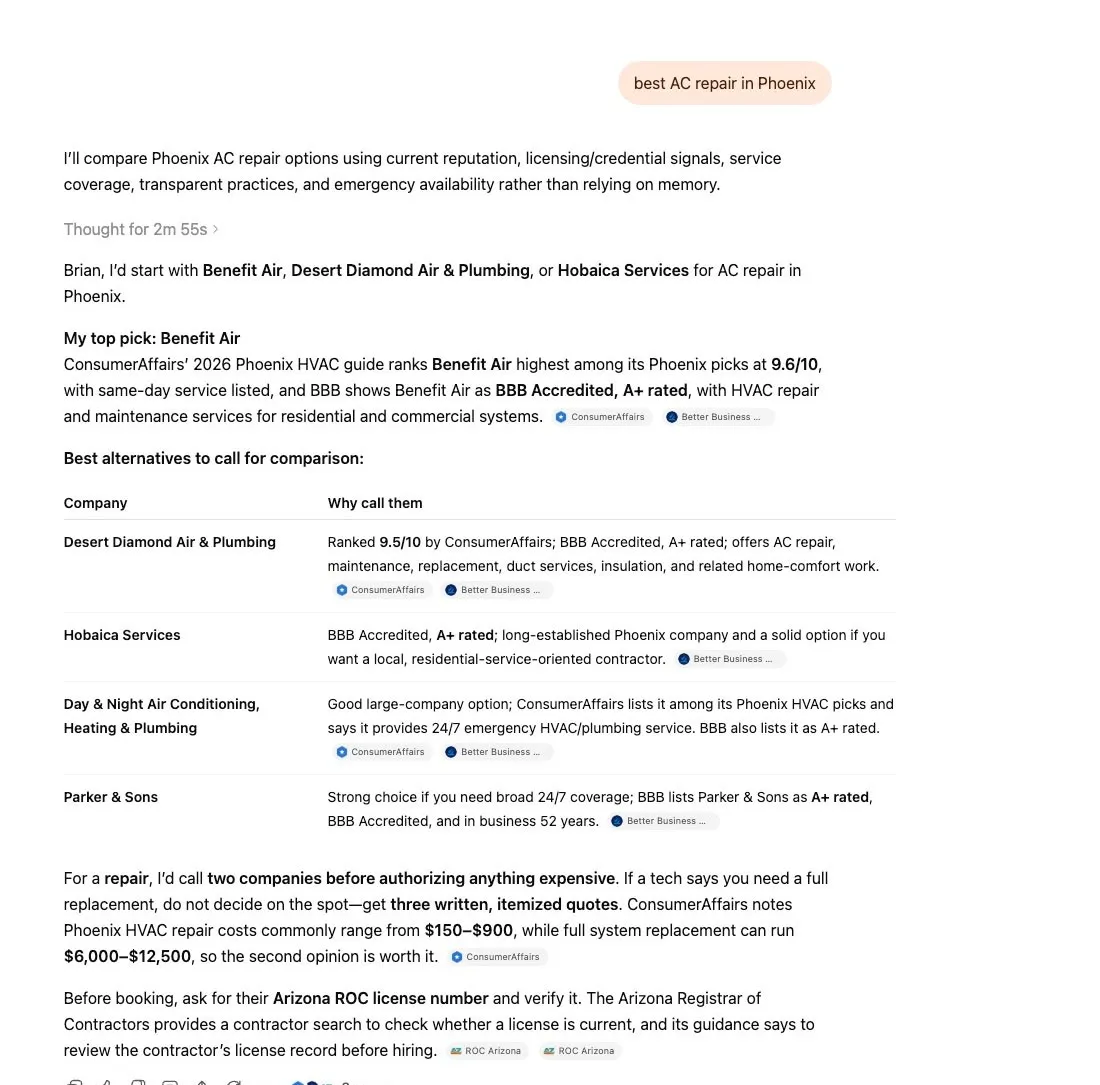
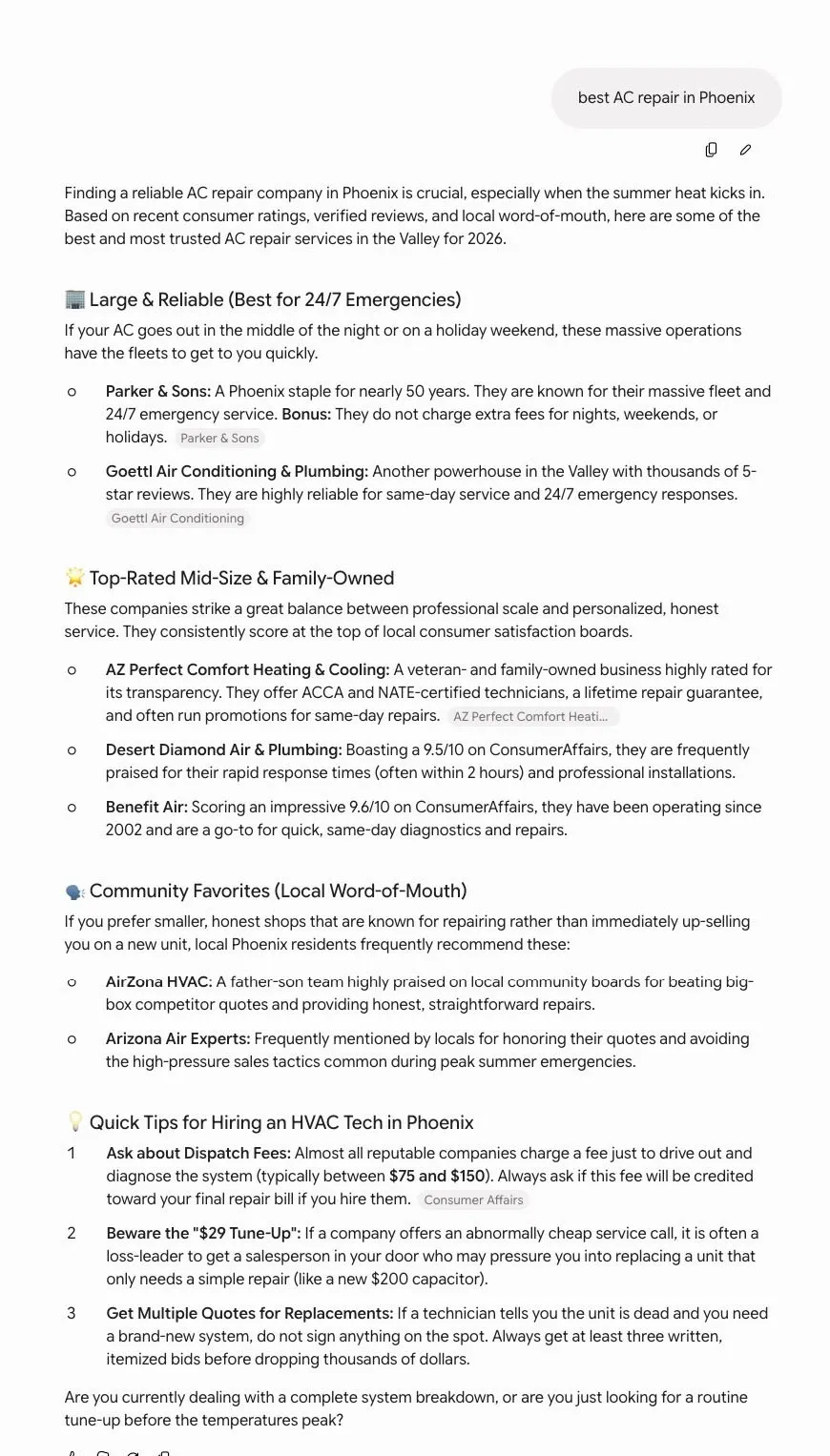
“Best AC repair in Phoenix.” ChatGPT researched for almost three minutes, then named a top pick — Benefit Air — plus four alternatives (Desert Diamond Air & Plumbing, Hobaica Services, Day & Night, Parker & Sons), citing ConsumerAffairs ratings, BBB accreditation, and years in business for each. Gemini named seven companies in tiers, from “large & reliable” down to “community favorites” it pulled from local boards.
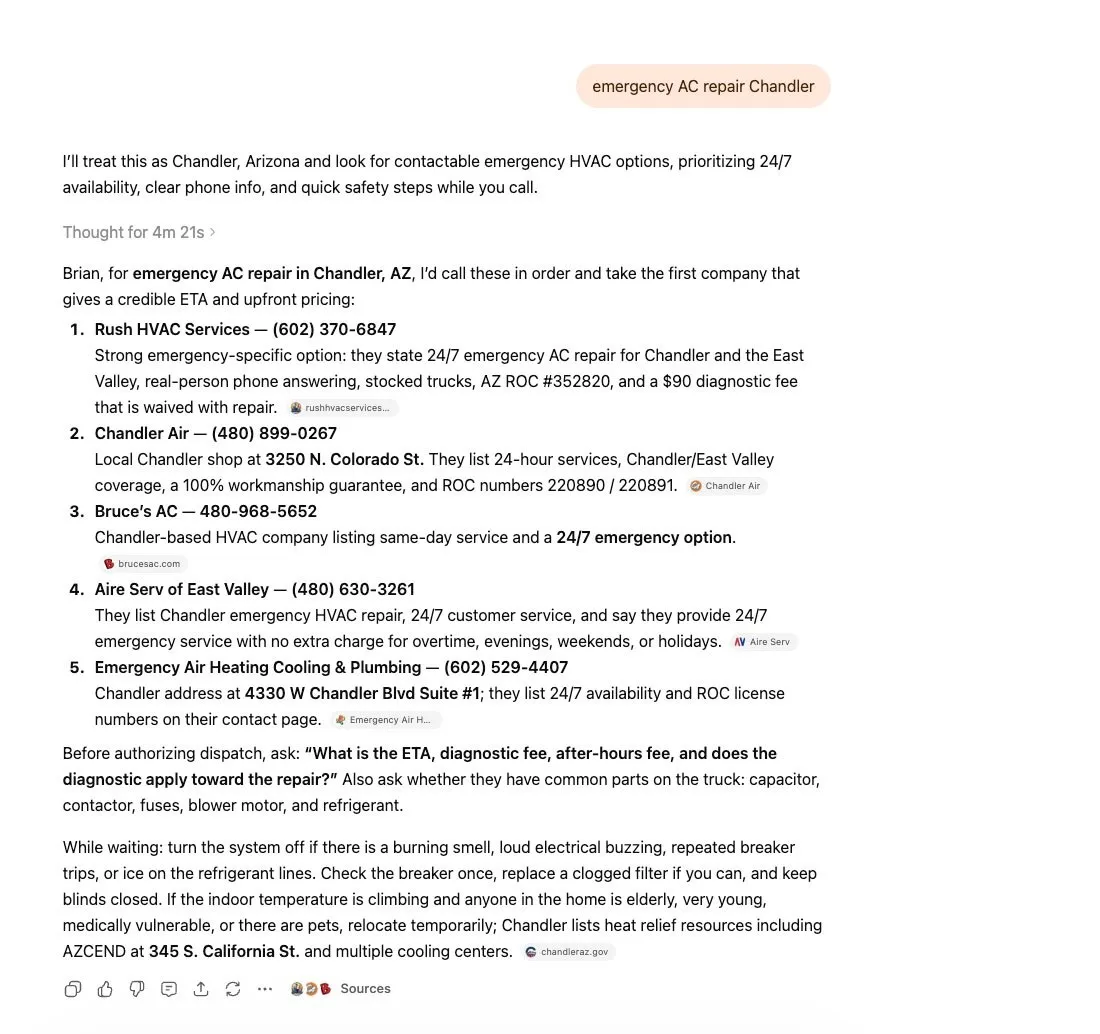
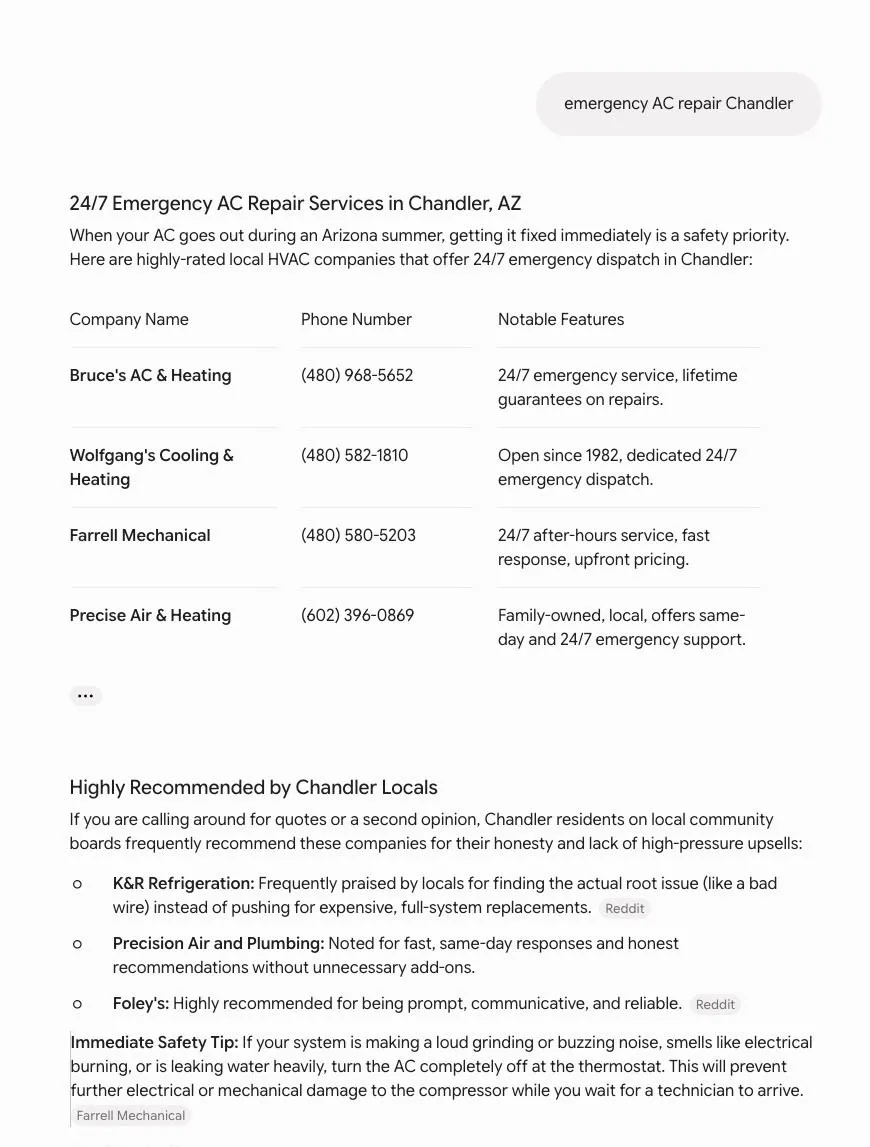
“Emergency AC repair Chandler.” This one should change how you think about your website. ChatGPT produced an ordered call list — “I’d call these in order” — and for each company it quoted facts from their own websites: Rush HVAC’s 24/7 coverage, Arizona ROC license #352820, and $90 diagnostic fee waived with repair; Chandler Air’s street address, ROC numbers, and 100% workmanship guarantee. The companies that published those details got recommended because the AI could read them. Gemini, meanwhile, built a phone-number table and added a “Highly Recommended by Chandler Locals” tier sourced from Reddit threads.
“AC repair Surprise AZ.” Same mechanics in the northwest Valley: ChatGPT’s table cited BBB profiles and — again — company websites (Bradford Heating & Cooling got its 4.8-star Google rating, 276 reviews, and ROC #353859 quoted straight from its own site). Gemini named five companies, four of them different from ChatGPT’s list.
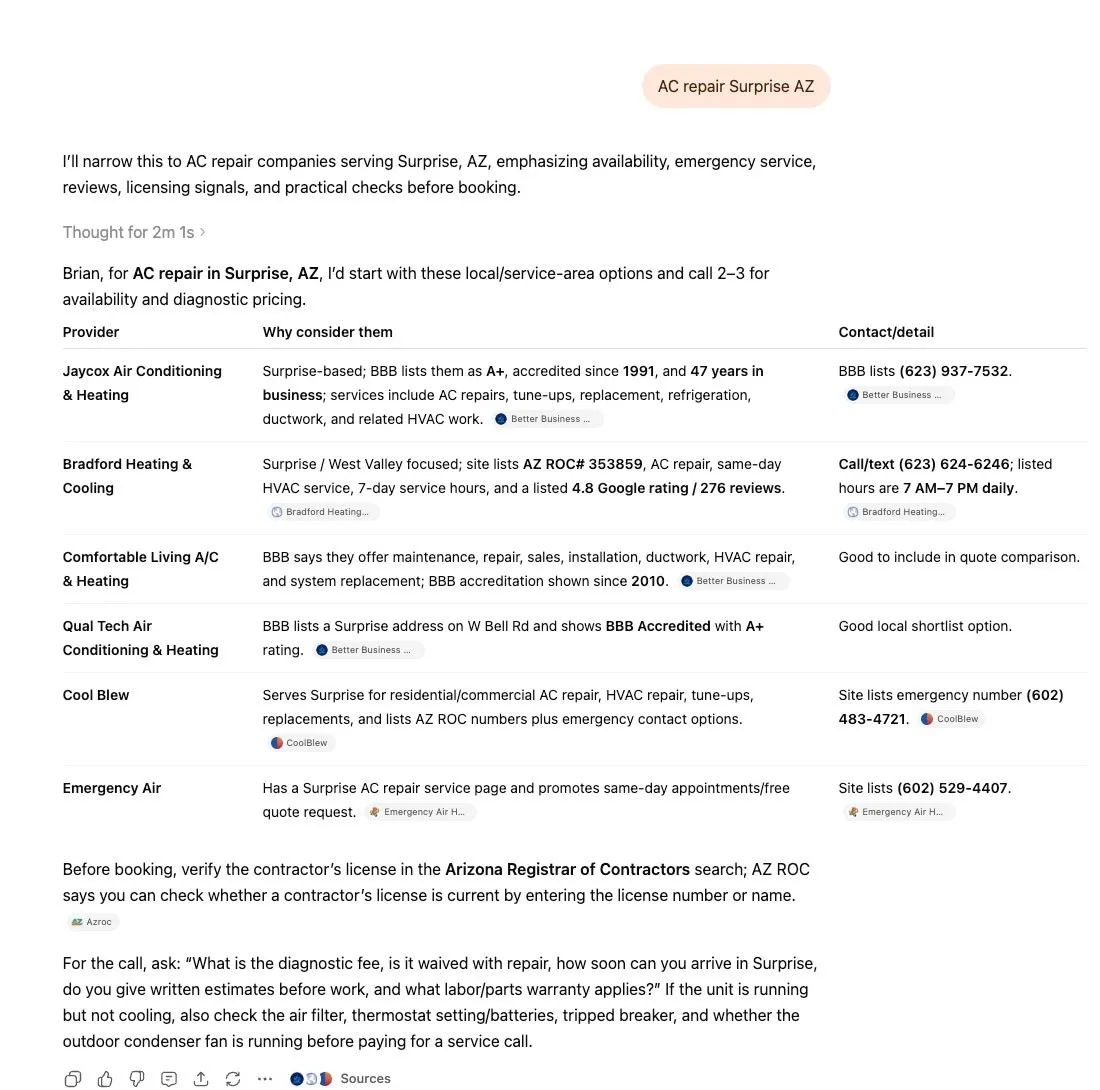
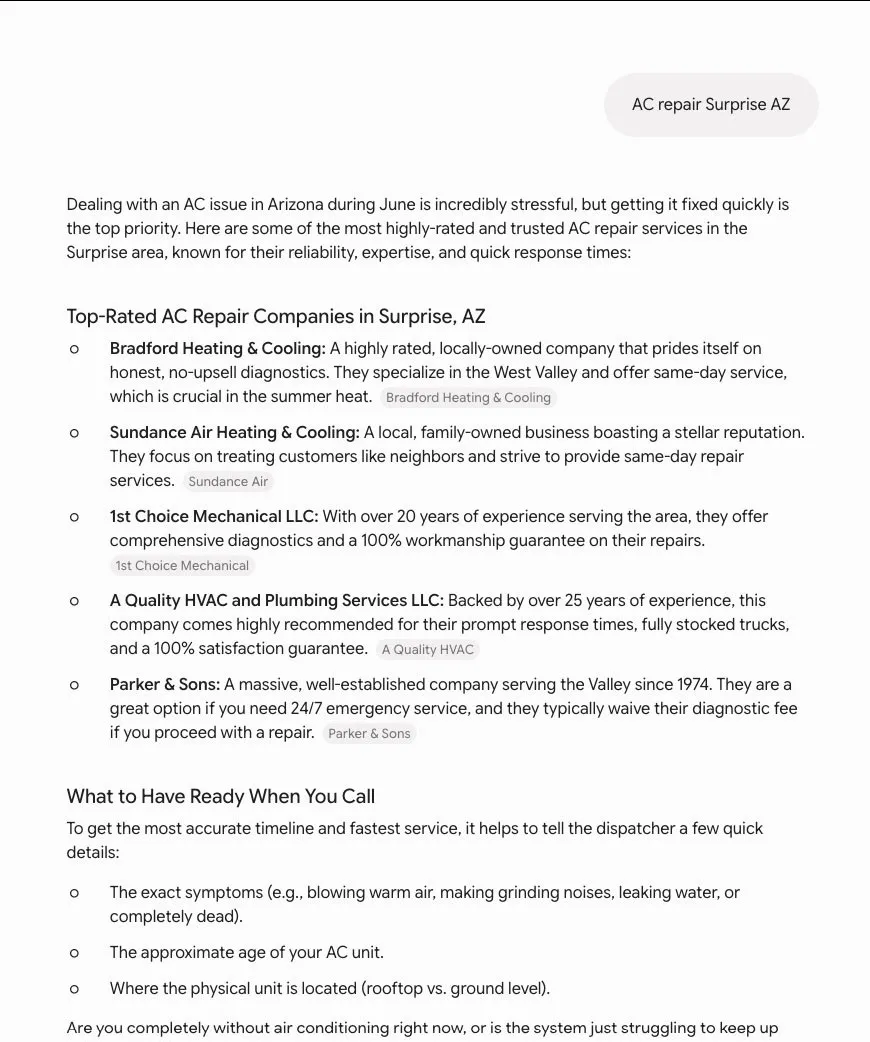
Three patterns from six answers, all verifiable in the screenshots:
- A handful of names, not ten blue links. Every answer recommended two to seven companies by name. If you’re not in that handful, you don’t exist for that homeowner.
- The companies’ own websites did the heavy lifting. ChatGPT quoted license numbers, diagnostic fees, service hours, and guarantees directly from company sites — exactly the machine-readable clarity most contractor sites lack. Third-party corroboration (BBB, ConsumerAffairs, Reddit, review counts) decided who made the list; the website supplied the facts that made the recommendation concrete.
- Each engine built a different list. Only a couple of companies appeared in both ChatGPT’s and Gemini’s answers for the same prompt. Visibility in one AI doesn’t mean visibility in another — which is why this is ongoing work, not a one-time trick.
(Answers captured June 11, 2026. AI answers change over time — that’s not a flaw in the method; it’s the reason visibility is ongoing work.)
How big is this for your business, honestly?
I won’t tell you that fixing your AI visibility will generate more business, because nobody can honestly promise that — marketing and sales are a lot more than showing up in a search result. Anyone who guarantees you calls from ChatGPT is selling snake oil.
What I can tell you is that showing up is the baseline expectation of a website. It’s table stakes. Fixing your AI visibility future-proofs the asset you already paid for, so that when a homeowner asks — whether they ask Google or ChatGPT — you’re at least in the room. After that, it’s on the business to do the rest: promote yourself, give people a reason to choose you, actually use your website as a marketing tool. (Quick tangent from years of audits: almost nobody has a lead magnet. A simple one gives you something real to market on Facebook or Instagram instead of just “we exist.” But that’s another article.)
The asymmetry is what makes this worth an afternoon of your attention. The homeowner asking an AI gets two or three names, not ten blue links. Being one of them costs you a set of fixable, verifiable website problems. Ignoring it costs you whatever those calls were worth — this cooling season and every one after it.
The first step is knowing where you stand, and that part takes ten seconds.